
Gold prospecting in Western Australia
Rules last checked 2 November 2026
The state's own mineral register lists 21,157 gold sites, from working mines to old dryblowing ground. Before you detect any of it, you need to know who holds the ground and what you are allowed to do there. This guide sets out the rules from the state's own documents.
At a glance
| Licence for Crown land | Miner's Right, $30 |
|---|---|
| Inside an exploration licence | 40E permit, $119, or the holder’s written permission |
| Inside a mining lease or prospecting licence | The holder’s written permission |
| Tools | Hand-held only, including a metal detector |
| Samples | Up to 20 kg on each occasion |
| Maximum penalty, individual | $150,000, plus $15,000 a day if it continues |
See who holds the ground before you go
Prospector Mate draws more than 30,000 live and pending WA tenements on the map, updated daily and free on the phone app, each with its status and number, and you can search them by number. The Prospector Mate Subscription adds search by holder name, tenement alerts on the ground you care about, gold sites, rock types, drill holes and pastoral stations. Download the area and the maps work with no reception.


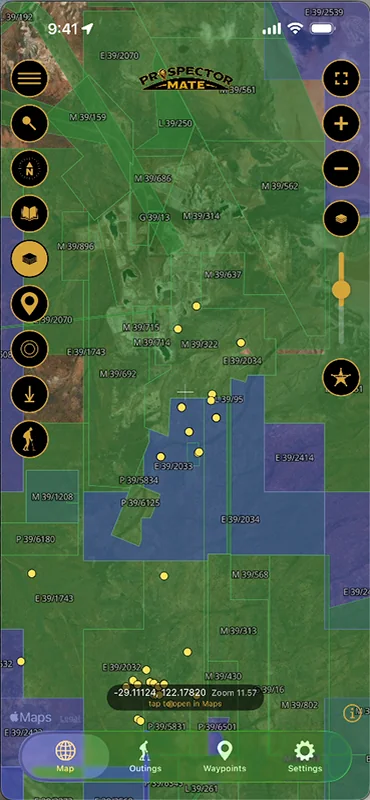
Where can you prospect in Western Australia?
The state has more than 30,000 live and pending mining tenements, and they change, so check the ground before you go and again just before you leave.
| Ground | Can you prospect there? |
|---|---|
| Crown land with no tenement | Yes, with a Miner's Right |
| Exploration licence | Yes, with a Miner's Right plus a 40E permit, or the holder's written permission |
| Mining lease | Only with the holder's written permission |
| Prospecting licence | Only with the holder's written permission |
| Pastoral lease | Yes, with a Miner's Right, and follow the pastoral rules below. Any tenement on it still applies |
| National park, nature reserve, townsite or other classified reserve | No. You cannot prospect there |
| Conservation land | Only with authorisation under the Conservation and Land Management Act 1984, as well as your Miner's Right |
| Private land, such as farmland | Not with a Miner's Right or a 40E permit. You need a permit to enter from a warden or prescribed official, for up to 30 days |
| State forest, timber reserve, water reserve or catchment area | Treat as closed until you’ve checked the reserve’s purpose and who manages it. Land reserved for a public purpose is not Crown land under the Act unless it is reserved for mining, a common or a public utility |
| Exclusive possession native title land | Only with permission from the relevant native title party |
WA has no designated fossicking areas, so what you can do depends on the land you are standing on. A gap in the tenement map is not a free pass: check for reserves, private land and native title too. The rules for private land and for crossing land are in the reference section.
How do you search WA tenements and set an alert?
Ground changes hands all the time. Prospector Mate lets you look up live and pending WA tenements, and tells you when something changes on the ground you care about.
| What you can do | Where it is |
|---|---|
| See tenements on the map, with status and number | Free on the phone app |
| Search by tenement number | Free on the phone app |
| Tap a tenement for its details | Prospector Mate Subscription |
| Search by holder name | Prospector Mate Subscription |
| Set WA Tenement Alerts | Prospector Mate Subscription |
To set an alert, open WA Tenement Alerts from the Tools section of the app menu. You can watch three things:
- A tenement: find it by its number, or tap Watch on any tenement on the map.
- An area: draw an alert area on the map around ground you are working or planning to peg.
- A holder: type a company or person, and the alert matches any holder whose name contains it.
For each one, choose what you want to hear about:
| Alert | What it tells you |
|---|---|
| New | A new application |
| Granted | A tenement has been granted |
| Holder | The holder has changed |
| Expiring | A tenement is nearing the end of its term, at 30, 7 and 1 days left |
| Gone | A tenement has been surrendered or has expired |
What you watch is matched on your phone and stays there, so we never see the ground you are interested in.
An alert means the public record has changed. The app checks it daily, so it is not instant, and an alert does not mean the ground is open. Confirm the status with the department before you rely on it.
What is a Section 40E permit?
A 40E permit lets a Miner's Right holder prospect on Crown land inside a granted exploration licence, within the blocks named on the permit, without the licence holder's consent. It costs $119 per application, however many blocks you choose, and lasts three months.
- It covers up to 10 joined graticular blocks in one exploration licence. A block is about 310 hectares.
- Up to three people can hold one permit, each with a current Miner’s Right, and all are jointly liable. It cannot be transferred.
- Hand-held tools only, with no power or hydraulic hand tools. Dig no deeper than 2 metres below the natural surface, and take no more than 20 kg of samples.
- Stay 100 metres away from any activity by or for the licence holder.
- List each vehicle by make, model and licence plate.
- Before you start, send a copy of the permit and its map to any affected pastoralist.
- Report any minerals recovered, with the quantity and exact location of each, to the department and the licence holder within 14 days of the permit ending, whether it expires, is cancelled or is surrendered.
Apply well ahead of your trip. You cannot enter for the first 21 days after the permit is issued, unless the licence holder sends you a licensee statement sooner.
Can you prospect on a pastoral lease?
Pastoral leases count as Crown land, so you can prospect on them with a Miner’s Right, but you have to work around the station. Take all reasonable and practical steps to tell the pastoralist where you will be and for how long, and tell them when you leave.
Without the written consent of the occupier, or a direction from a Warden, you cannot prospect:
- Within 400 metres of the outer edge of any water works, race, dam, well or bore on a pastoral or diversification lease. The only exception is an old mining excavation made by someone other than the lessee, so do not assume abandoned-looking gear is exempt.
- Within 100 metres of a yard, stockyard, garden, cultivated field, orchard, vineyard, plantation, airstrip or airfield, or of occupied land with a house or other substantial building on it.
- On, or within 100 metres of, land under crop, a cemetery or burial ground, a permanent electrical or fibre optic cable, or a substantial structure on a diversification lease that is being built or is in use.
You can still pass over this land to reach available land. Camp at least 400 metres from stock water and leave gates as you find them. The rest of the station rules, on crossing, damage, dogs and firearms, are in the reference section.
Do you need a Miner's Right, and what can you use?
Yes. A Miner's Right is the basic permit for recreational prospecting. The fee is $30 for 2026-27, from 1 July 2026. It has no end date, and it cannot be transferred to anyone else. Get one online through the department, from any Mining Registrar's office, from Mineral House in East Perth, or by post. You will need identification showing your full name, including any middle names.
How to get a Miner's Right online, from the department
On available land, meaning Crown land not under a mining tenement, it lets you prospect with hand-held tools such as a metal detector, take and keep samples or specimens of up to 20 kg on each occasion, camp on Crown land to prospect, and take water from natural springs, lakes, pools and watercourses on that land for prospecting and domestic use, subject to the Rights in Water and Irrigation Act 1914. Crown land includes vacant Crown land and pastoral leases, but not freehold land, townsites or most reserved land.
| Method | Can you use it with a Miner's Right? |
|---|---|
| Pan, sieve, pick, shovel | Yes. These are hand tools |
| Metal detector | Yes, for prospecting. It is a hand-held tool |
| Hand dryblower, non-powered sluice, rocker or shaker | We read WA’s hand-tool rule as allowing these when operated by hand without a motor or powered pump |
| Powered dryblower, shaker, highbanker or pump, or a dredge | No. Needs a mining tenement, such as a prospecting licence |
No explosives. A Miner's Right is for prospecting, which means testing ground to decide whether to apply for a tenement, and it does not authorise mining operations, so you can generally disturb very little ground.
Fossicking is a separate thing. It means collecting rock, ore or minerals other than gold or diamonds, it needs prior written consent from the occupier and any tenement holder, and a metal detector cannot be used for it. Detecting for gold is prospecting.
Rules to know before you dig
- Backfill your holes and make them safe. Do not remove fencing or timber placed around an old shaft or pit.
- Leave creek beds and banks alone. On Crown land, the Rights in Water and Irrigation Act 1914 makes it an offence to obstruct, destroy or interfere with the waters, bed or banks of a watercourse without a permit or the authority of another Act, and your Miner’s Right is subject to that Act.
- Old mullock and tailings are not free ground. Earth counts as mined even if it was disturbed before.
- Gold from someone else's tenement is not yours to keep unless you hold the holder's written permission or a 40E permit. Under a 40E permit you may take samples of up to 20 kg on each occasion, and you must report what you recovered to the department and the licence holder within 14 days of the permit ending.
- Keep your Miner's Right legible. Police and authorised officers can ask to see evidence of your right to be on the land.
- Take your rubbish with you and leave the area clean. Take all necessary steps to prevent fire and damage to trees, property and livestock. On a mining tenement, tell the holder when you have finished.
- Carry enough water, fuel, maps and first aid supplies, and a registered Personal Locator Beacon.
Aboriginal heritage: all Aboriginal cultural heritage in the state is protected, whether or not it is on the register, and sites are not always signposted or shown on public maps. A Miner's Right or permit does not authorise you to disturb it. Search the Department of Planning, Lands and Heritage's Aboriginal Cultural Heritage Inquiry System (ACHIS) before you go, but finding nothing does not mean nothing is there. If you come across a possible site or object, leave it alone and report it to the Registrar or a police officer.
Where the gold has been found
Small gold discoveries were made in the Kimberley in the late 1880s. The big boom followed the alluvial gold found at Coolgardie in 1892 and the deposits at Kalgoorlie in 1893. Nearly all of the state's gold country is Archean rock, which takes in basalt, granite and ultramafic units.
MINEDEX, the state register of mineral sites, records what each working is. It holds these gold sites:
| Recorded gold sites | Count |
|---|---|
| All gold sites | 21,157 |
| Listed as shut or abandoned | 13,685 |
| Open pits | 2,644 |
| Shafts | 1,025 |
| Shallow workings | 464 |
| Scraping or detecting areas | 435 |
| Dryblowing areas | 111 |
| Operating | 537 |
Most sites record no working type, so the working types do not add up to the total, and the rows overlap because a site has both a status and a working type.
A recorded site means gold was found there once, not how much. It does not mean you may go there, because it could be inside a live tenement or on land you cannot enter.
How Prospector Mate helps in Western Australia
Prospector Mate puts the official records on one map and keeps working with no reception once you have downloaded the area. It does not decide whether you may be on the ground. That is still your job, using the rules above.
- Mining Tenements, tenement search and WA Tenement Alerts, as described above.
- Old Tenements: 422,608 expired, surrendered and forfeited tenements.
- Pastoral Stations: names and lease numbers for 488 stations, so you know whose station you are on.
- Historical Gold: all 21,157 gold sites, with what each working is.
- Gold Geochemistry: 5,313,996 surface samples with their gold results.
- Drill Holes: 2,530,594 open-file holes and the best gold each one found.
- Rock Types and Gold Hosting Ground: the mapped rock units, and the 3,461 of them with recorded gold.
- Outings: Prospector Mate records your track as you detect, even with the screen off and no mobile reception. Mark each find where you dug it up, add a photo and record the gear you used. Load a previous outing onto the map to see where you’ve already covered ground before you head out again.
- Back to Vehicle: See the distance and direction to your starting point throughout the outing.
Your outings, finds, photos and waypoints stay on your phone. Bare Ground LiDAR Relief is not currently available for Western Australia.
Check the ground before you leave home
See it on your phone, even with no reception.
Common questions
Do I need a Miner's Right to use a metal detector in WA?
Yes, if you are prospecting on Crown land. A metal detector is a hand-held tool allowed under a Miner's Right, which has no end date, so you pay once. You also need the right permission for any tenement on the land.
What is a 40E permit?
It is a permit for a Miner's Right holder to prospect inside a granted exploration licence, for three months, with hand-held tools. You generally cannot enter for the first 21 days, so apply well ahead.
Can I prospect on a pastoral station?
Yes, with a Miner's Right, because pastoral leases count as Crown land. Tell the pastoralist where you will be, and without written consent stay 400 metres from waters such as dams, wells and bores, and 100 metres from yards and occupied buildings. Any tenement on the station still applies: inside an exploration licence you need a 40E permit or the holder's permission, and a mining lease or prospecting licence needs the holder's written permission.
Can I keep the gold I find?
Yes, on Crown land not covered by a mining tenement, as samples of up to 20 kg on each occasion. On a tenement where the holder gave you written permission, it depends on your agreement. Under a 40E permit you keep what you recover within the same 20 kg limit, and you must report it to the department and the licence holder within 14 days of the permit expiring, being cancelled or being surrendered.
Can I get an alert when a tenement changes?
Yes. With the Prospector Mate Subscription, WA Tenement Alerts can watch a tenement, an area you draw or a holder, and tell you about new applications, grants, holder changes, tenements nearing the end of their term and tenements that are surrendered or expire.
Reference: penalties, fees and more
Pastoral leases in more detail
You can still pass over the protected land on a pastoral lease to reach available land. Keep your passes to the minimum, follow any reasonable request from the pastoralist, including about stock water, firearms and dogs, and make good any damage. You can be liable to pay compensation for damage to infrastructure such as fences and tracks.
Camp at least 400 metres from stock water, and leave gates as you find them. Dogs are restricted without the pastoralist's consent, and penalties apply under the Firearms Act 2024 for carrying or using firearms on a pastoral lease without consent.
Private land and crossing other land
You may not cross private or reserved land to reach other Crown land, unless the reserve is for a common, mining or public utility purpose.
A Miner's Right or a 40E permit does not cover private land. You need a permit to enter from a warden or prescribed official, for up to 30 days. It costs $10.50 per lot, with a $41 minimum. The warden or official must be satisfied you are applying in good faith, can set conditions, and can require a sum to compensate the owner and occupier. Contact the landowner before you enter.
The step up from a Miner's Right
A prospecting licence is the step up from a Miner's Right: up to 200 hectares, and up to 500 tonnes of material under its conditions. Powered equipment and machinery need a mining tenement such as this.
Aboriginal heritage in more detail
It is an offence to excavate, destroy, damage, conceal or in any way alter an Aboriginal site, or to remove or alter an object on or under one, without the required authorisation or consent. If you know of an Aboriginal site or object, or a place or thing that might reasonably be one, you must report it to the Registrar or a police officer, unless you have reasonable cause to think it is already known.
| Individual, under section 57 | Maximum penalty |
|---|---|
| First offence | $20,000 and 9 months in prison |
| Second or later offence | $40,000 and 2 years in prison |
| If the offence continues | A daily penalty of $400 |
Penalties
These are the Mining Act and related penalties. Aboriginal heritage penalties are separate and are listed in the heritage panel above.
| Offence | Penalty | Law |
|---|---|---|
| Mining, including prospecting, without authority | $150,000 for an individual, plus $15,000 a day if it continues | Mining Act s 155 |
| Removing minerals from another person's tenement without authority | $20,000, plus $2,000 a day if it continues. This is treated as stolen from the Crown, and finds can be confiscated | Mining Act ss 156(1)(a) and 154(2); department guide 2026 |
| Refusing to show evidence of your right to be there, or obstructing or misleading an officer | $10,000 | Mining Act s 158(2) |
| Not stopping when directed | $10,000, and you and your machinery can be removed | Mining Act s 158(4)-(5) |
| Breaching a 40E permit condition | Up to $5,000, cancellation, and up to 3 years disqualified from permits | Mining Regulations r 4L |
| Discharging a firearm on Crown land without permission or reasonable excuse | $20,000, plus $400 a day if it continues | Land Administration Act s 267(2)(h) |
Sources
This is a general guide, not legal advice. Fees and rules change, and you are responsible for knowing the law, so confirm anything you rely on with the regulator. Gold site counts are from the official register as built into the app on 14 September 2026.
- Prospecting on Crown land in Western Australia, 2026 edition - Department of Mines, Petroleum and Exploration, June 2026
- Getting a Miner's Right - Updated 19 June 2026
- Where you can prospect with a Miner's Right - Updated 19 June 2026
- Mining Regulations 1981, regulations 4, 4C, 4L, 4N, 4O and 74A - Current version 12-af0-00, from 1 July 2026
- Search Aboriginal cultural heritage places in WA - ACHIS, Department of Planning, Lands and Heritage
- Aboriginal Heritage Act 1972 - Version 04-n0-00
- Land Administration Act 1997, section 267 - Version 07-j0-00
- Miner's Rights, DMPE - Updated 19 June 2026
- Water in mining - Updated 7 November 2024
- Rights in Water and Irrigation Act 1914 - Version 09-d0-00
- Mining Act 1978, sections 8, 20, 28, 30, 40C, 40D, 40E, 154, 155, 156 and 158 - As at 28 May 2026, version 09-q0-00
- Miner's Rights pamphlet - Department of Mines, Industry Regulation and Safety, revised March 2023
- Seven Golden Rules for Prospecting - Department of Mines, Petroleum and Exploration, July 2025
- Fees and Charges 2026-27 - Effective 1 July 2026
- Section 40E Permit System - Page updated 19 June 2026; detailed pamphlet revised July 2020
- Section 40E Permit Conditions - Department of Mines, Petroleum and Exploration, last updated 9 April 2025
- Prospecting obligations on Crown land - Page updated 19 June 2026
- Gold, State Library of Western Australia - History dates
- MINEDEX mineral register - Site counts, Department of Mines, Petroleum and Exploration, CC BY 4.0